-
Improve Your Learning and Memory.: Your Kid May Be Smart. Just Don’t Tell Him So Too Often
Every kd isn't smart but every kid (and adult) needs a "growth mindset." Please read this article. "Research by Carol Dweck and colleagues at Stanford demonstrated that the students who are most likely to learn from their mistakes are those who don’t think of themselves as smart as such but smart enough to get smarter. They have a “growth mindset,” a belief system that they can get better if they will just invest the time and effort."
"In one of the group’s experiments, half of the students were repeatedly praised for “being smart,” and these students were not good at learning from mistakes. It is not clear why. Maybe they thought the problem was in the learning material, not in them. The other half of students were praised for effort and improvement and these students got better and made fewer mistakes. Several months later, all students repeated a standardized test, and the “smart” students’ scores dropped 20%, while the “growth mindset” students scored 30% higher." Praise students for effort not for being smart. bottom line. everyone is not a genius -
Ignoring What Works in Education, The Umbrella Man, and The Challenge of Framing
Prepare to be challenged as you read Ewan McIntosh's thought provokingnpost on formative assessment and why it is being ignored or misrepresented. i have some reading to do with the links he gives. this is one of those must reads for thought leaders.
Showing posts with label administrator. Show all posts
Showing posts with label administrator. Show all posts
Wednesday, December 28, 2011
Teach This! Teaching with lesson plans and ideas that rock #teaching 12/28/2011
Wednesday, December 14, 2011
Shooting Hoops in the Hallways of Learning
 |
| I wrote this at halftime last night. Here was my view. |
And sometimes. Air ball. Literally. The paper is flying at the trash can, at each other...at you. The kids are disruptive. Every time you turn your back -whoosh someone disappears from his seat. Not a good day.
The goal is to have more excellent days....to get more net than air. To score learning. The principals know who their star players are. The teachers who consistently get results. They also known their inconsistent players who really need more practice before hitting the court in a game.
Therein comes the big difference between basketball and teaching. Everyone starts. Everyone.
All full time teachers are starters because every full time teacher is a student's only chance to learn that topic. This is why having the best team possible is essential. There is no such thing as a bench in a school. Everyone plays.
Except this is not play. This is serious. If someone continues to foul. If they commit too many personal fouls or disrespect the referee, eventually a good ref will eject that player or coach.

We can't afford to have teachers with poor personal skills in the classroom. We can't afford to have teachers who can't ring a basket on a good day teaching. Likewise, we can't afford to lose our best players. We need to keep the stars playing on our team. Experience counts. Energy counts. You can have all the moves in the world but if you only shoot air balls (your teaching doesn't produce results) perhaps you need to slow down and be more simple and just shoot lay ups.
If you are a basketball fan (like me) -the next time you watch a game, think about this and how seriously we must scrutinize our teaching team. If no one wants to play on your team and you are just looking for any warm body who will walk in your school then you have to look at those leading your school system and improve the learning environment.
Learning is serious. We need to do it well. Be excellent. Be great. Be world class. Play well and serve in the greatest (most unappreciated) profession.
The future is in your halls. And we can't afford to miss this one.
- Posted using BlogPress from my iPad
Photo Credit
Personal photo - Players at halftime of Fullington and Westwood Game, December 13, 2011
Bigstock
Monday, December 12, 2011
12 Amazing Ways to Teach During the Crazy Days of Christmas
Some teachers are tempted to be babysitters during the holidays when, in fact, you can get some powerful teaching moments in your classroom. Take time to be creative and integrate holiday-themed teaching into your classroom. Please share what you like to do in the comments.
1 - Have a Social media activity relating to topics you're learning
Two of my most tweeted things from last week were the Facebook template and Twitter template that you can download and use in Microsoft Word. This is a great alternative for those of you who cannot use the online Fakebook template from Classtools.net.
Our AP Literature teacher has had students create a Facebook profile for their term paper author. They have to add at least 8 "friends" who are contemporaries of the author, a certain number of status updates with comments from friends. All of it must be believable. It is a lot of fun because students have to research their person, figure out the contemporaries and understand aspects of his/her life.
These spark fun conversations and can be done offline or online.
2 - Make an Interactive Story
This is a great time of year to teach students how to create interactive stories using PowerPoint. You can have them illustrate a popular story (like this Night Before Christmas PowerPoint) with their own narration or create an interactive story talking about their family. (see a review for Powerpoint 2007) The concepts you can teach with this idea:
3 - Make a Review Game (to promote future recall)
If you're doing reviews, and know that content you shared this semester will need to be recalled next semester, you can have the students create fun review games using PowerPoint (see the video below.) You can save them and review. If you don't have Powerpoint, use the Free flash Online Jeopardy Generator and have them save the file or embed on your wiki for review later.
4 - Play Games to Learn
For elementary teachers, TES has the 12 games of Christmas which are perfect for the whiteboard. If you want to play this on the ipad, the last three games (the santa addition game - #11 is my favorite for my 10 year old) are available for free. You can download the game from the iTunes store. (There are 3 games in the app - a sequencing game with ringing bells, and a velocity and angle game where you shoot an elf at presents to grab them and get them into Santa's sack.) There is a free downloadable teaching guide for these games, a big plus. (On another note, you can write a review and tweet it with #tesxmas to Twitter and win an ipad on Friday.)
But you could take this further if you have older students. Why not come up with your own 12 games of Christmas and embed them in a wiki by having students create their own games at classtools.net? These can be used for review next semester before testing. You could start playing eLections to understand how elections work or make your own class stock market game. (I use the one at Market Watch.)
You could also take some of the fun holiday games over at Kaboose and adapt them to your classroom or activity.
5- Play Games to Make the World a Better Place
Or how about selecting a game that can change the world like Free Rice (answer vocabulary questions and rice is donated to areas in need), Darfur is Dying (not a happy game for Christmas but one that could give perspective), or other games that bring awareness to social issues. (Like Disaster watch, citizen Ship, or the Carpet game.)
6 - Make Games
There are a lot of places to make your own video games: Sploder (for arcade games) or MIT's Scratch or Microsoft's Kodu Game Lab. All of these are free. As the K12 online conference 2011 said, "Play with a Purpose."
7 - Create your efolio
The end of a semester is a great time to update (or create) your efolio. All of my students have their own website and their parents know the links. When they graduate, they put the links on college applications and resumes. My favorite place for student efolio websites is Weebly, but you could also do this on Google sites.
8- Create a DVD for the family
Use Photostory (free for PC), or iMovie or Windows Live Movie maker (free for PC) to make a simple DVD movie for the child's family. These are fun, simple programs that have built in tools to help make simple videos out of family photographs. If you do this option, my best recommendation is to have students bring the photos in already scanned on a CD or DVD or to have time outside class when students can scan photos.
9- Digital Picture Frame or Digital Jump Drive
The best picture I gave last year to my family was a digital picture frame with pictures from the year on it. My Mom keeps hers running in the kitchen all the time. You can get a nice Digital Picture Frame from Amazon for 20 something plus a memory card for a total of around $30. This would be a great gift for the principal or front office to have photographs and works of art. How about having students scan their work form the year and creating a digital portfolio for their parents using a digital picture frame? (You can also find small digital keychains for photos as well. I have seen them but don't have a specific one to recommend.)
You could even have students scan or photograph their work and take photos and put these items on a jump drive and give the jump drive for Christmas. Both of these gift ideas cost a little money but would be nice for parents or principals.
10- Make Christmas Cards or Have Fun with Photos
I have students create a movie poster using Adobe Photoshop to photoshop their face onto a movie poster. Then, we have the students assemble Christmas cards for the school board of directors to send to parents. If you teach graphic design, Christmas or Holiday cards are great things to do.
There are also many online websites like Blue Mountain where you can make ecards and send them to family. You could use this to introduce younger kids to email. You can also have students bring in family pictures and learn to scan them and pull them into a funny holiday site like Elf Yourself. (Or they can help you do this activity with the faces of teachers or administrators.) You could also use an app like Face in the Hole.
Speaking of fun with pictures, Big Huge Labs is a blast for anyone and can help you make fun, frameable signs like the one I made for my school's state championship football team.
11- Solve Santa's Murder
OK, this is a very different kind of activity, but I think that is why I like it. It is a writing activity but has students use clues to solve Santa's murder mystery. It is no secret that I spend quite a bit of time running around the free TES resources and this is another one I turned up there. Probably better for middle school but would spark interest.
12 - Share Your Ideas
Share your ideas for teaching during the holidays with others. Sometimes seeing what other teachers are doing is so helpful. For example, Widad Kinard has a lovely Pinterest board with classroom activity ideas overflowing with holiday ideas straight from her classroom.
Share on your blog (like I've done here.) Certainly there are many great ideas out there. Send them through your favorite hashtag on Twitter. (See Jerry Blumengarten's Hashtag Guide -he's @cybraryman1 on Twitter.)
Teach!
There are so many things you can do that will teach students.You don't have to watch another movie. But if you do, watch a classic movie. They will watch popular movies at home (most likely) but A Christmas Carol or "It's a Wonderful Life" will give the kids an insight into culture. There are lot of classic movies you can watch.
Recess is great but three recesses are a bit extreme in one day.
Some teachers go on autopilot this time of year and become glorified babysitters. You are too good for that. This is the week that separates the good from the great. Use every moment and find the power of teachable moments. As kids play and relax in other classes, they may just have more mental energy for your subject than you realize.
Take time and use your time! Please share your ideas in the comments.
1 - Have a Social media activity relating to topics you're learning
Two of my most tweeted things from last week were the Facebook template and Twitter template that you can download and use in Microsoft Word. This is a great alternative for those of you who cannot use the online Fakebook template from Classtools.net.
Our AP Literature teacher has had students create a Facebook profile for their term paper author. They have to add at least 8 "friends" who are contemporaries of the author, a certain number of status updates with comments from friends. All of it must be believable. It is a lot of fun because students have to research their person, figure out the contemporaries and understand aspects of his/her life.
These spark fun conversations and can be done offline or online.
2 - Make an Interactive Story
This is a great time of year to teach students how to create interactive stories using PowerPoint. You can have them illustrate a popular story (like this Night Before Christmas PowerPoint) with their own narration or create an interactive story talking about their family. (see a review for Powerpoint 2007) The concepts you can teach with this idea:
- Clickable hotspots (where you click and make a choice - this is basic programming)
- Recording narration
- Creating a self-running PowerPoint
3 - Make a Review Game (to promote future recall)
If you're doing reviews, and know that content you shared this semester will need to be recalled next semester, you can have the students create fun review games using PowerPoint (see the video below.) You can save them and review. If you don't have Powerpoint, use the Free flash Online Jeopardy Generator and have them save the file or embed on your wiki for review later.
4 - Play Games to Learn
For elementary teachers, TES has the 12 games of Christmas which are perfect for the whiteboard. If you want to play this on the ipad, the last three games (the santa addition game - #11 is my favorite for my 10 year old) are available for free. You can download the game from the iTunes store. (There are 3 games in the app - a sequencing game with ringing bells, and a velocity and angle game where you shoot an elf at presents to grab them and get them into Santa's sack.) There is a free downloadable teaching guide for these games, a big plus. (On another note, you can write a review and tweet it with #tesxmas to Twitter and win an ipad on Friday.)
But you could take this further if you have older students. Why not come up with your own 12 games of Christmas and embed them in a wiki by having students create their own games at classtools.net? These can be used for review next semester before testing. You could start playing eLections to understand how elections work or make your own class stock market game. (I use the one at Market Watch.)
You could also take some of the fun holiday games over at Kaboose and adapt them to your classroom or activity.
5- Play Games to Make the World a Better Place
Or how about selecting a game that can change the world like Free Rice (answer vocabulary questions and rice is donated to areas in need), Darfur is Dying (not a happy game for Christmas but one that could give perspective), or other games that bring awareness to social issues. (Like Disaster watch, citizen Ship, or the Carpet game.)
6 - Make Games
There are a lot of places to make your own video games: Sploder (for arcade games) or MIT's Scratch or Microsoft's Kodu Game Lab. All of these are free. As the K12 online conference 2011 said, "Play with a Purpose."
7 - Create your efolio
The end of a semester is a great time to update (or create) your efolio. All of my students have their own website and their parents know the links. When they graduate, they put the links on college applications and resumes. My favorite place for student efolio websites is Weebly, but you could also do this on Google sites.
8- Create a DVD for the family
Use Photostory (free for PC), or iMovie or Windows Live Movie maker (free for PC) to make a simple DVD movie for the child's family. These are fun, simple programs that have built in tools to help make simple videos out of family photographs. If you do this option, my best recommendation is to have students bring the photos in already scanned on a CD or DVD or to have time outside class when students can scan photos.
9- Digital Picture Frame or Digital Jump Drive
The best picture I gave last year to my family was a digital picture frame with pictures from the year on it. My Mom keeps hers running in the kitchen all the time. You can get a nice Digital Picture Frame
from Amazon for 20 something plus a memory card for a total of around $30. This would be a great gift for the principal or front office to have photographs and works of art. How about having students scan their work form the year and creating a digital portfolio for their parents using a digital picture frame? (You can also find small digital keychains for photos as well. I have seen them but don't have a specific one to recommend.)You could even have students scan or photograph their work and take photos and put these items on a jump drive and give the jump drive for Christmas. Both of these gift ideas cost a little money but would be nice for parents or principals.
10- Make Christmas Cards or Have Fun with Photos
I have students create a movie poster using Adobe Photoshop to photoshop their face onto a movie poster. Then, we have the students assemble Christmas cards for the school board of directors to send to parents. If you teach graphic design, Christmas or Holiday cards are great things to do.
 |
| Have fun with Photos at Big Huge Labs |
Speaking of fun with pictures, Big Huge Labs is a blast for anyone and can help you make fun, frameable signs like the one I made for my school's state championship football team.
11- Solve Santa's Murder
OK, this is a very different kind of activity, but I think that is why I like it. It is a writing activity but has students use clues to solve Santa's murder mystery. It is no secret that I spend quite a bit of time running around the free TES resources and this is another one I turned up there. Probably better for middle school but would spark interest.
 |
| Widad Kinard's Pinterest board with classroom activities |
12 - Share Your Ideas
Share your ideas for teaching during the holidays with others. Sometimes seeing what other teachers are doing is so helpful. For example, Widad Kinard has a lovely Pinterest board with classroom activity ideas overflowing with holiday ideas straight from her classroom.
Share on your blog (like I've done here.) Certainly there are many great ideas out there. Send them through your favorite hashtag on Twitter. (See Jerry Blumengarten's Hashtag Guide -he's @cybraryman1 on Twitter.)
Teach!
There are so many things you can do that will teach students.You don't have to watch another movie. But if you do, watch a classic movie. They will watch popular movies at home (most likely) but A Christmas Carol or "It's a Wonderful Life" will give the kids an insight into culture. There are lot of classic movies you can watch.
Recess is great but three recesses are a bit extreme in one day.
Some teachers go on autopilot this time of year and become glorified babysitters. You are too good for that. This is the week that separates the good from the great. Use every moment and find the power of teachable moments. As kids play and relax in other classes, they may just have more mental energy for your subject than you realize.
Take time and use your time! Please share your ideas in the comments.
Friday, December 2, 2011
Lead the World! #k12online11 Video from Vicki Davis and Julie Lindsay
As team captains, Julie and I were asked to bring forth our comments about leading global collaborative projects and we have some very current comments on what we're doing now in there. Look forward to hearing your thoughts and feedback.
Presenters:
Vicki Davis, Julie Lindsay with Curt Bonk, Anne Mirtschin, Judy O'Connell, Dean Shareski, Don Tapscott, David Warlick, Flat Classroom conference students - Doha Qatar, Suffern Middle School (Peggy Sheehy and Marianne Malmstrom), Mt. Carmel High School (Suzie Nestico), Phoenix School (Betsye Sargent), West Tisbury (Valerie Becker), and Flat Classroom StudentsDescription:
Students are the greatest textbook ever written for each other, yet, many schools close the book on learning outside classroom walls. After five years of global collaborative classroom excellence, this presentation first uses voices from the keynoters, students, and teachers around the world that have been part of the Flat Classroom projects and conferences to share how education has fundamentally changed through a beautiful medley of voices.Then, hear from Vicki Davis, co-founder, about the 7 principles that can take your classroom global and the current challenges and misconceptions surrounding what it means to globalize your classroom. (Read more about these in Flattening Classrooms, Engaging Minds by Vicki Davis and Julie Lindsay)
We hope you'll join this journey of learning and thank all of our keynoters, students, and teachers, for sharing their voice in this move towards excellence in global education.
Credits:
Video has been used from past Flat Classroom project keynotes, student presentations, and the Flat Classroom conference. The full videos have been linked below and we encourage you to view all of these videos. All keynote videos of our projects have been linked. Due to some technical difficulties 2-3 videos were not able to be incorporated into this k12 online presentation and for that, Vicki Davis, producer of this video sincerely apologizes. We are working to download and process the full version of your videos so that this will not be a problem should this style be used in the future.
Dean Shareski FCP2007
Terry Freedman FCP 2008
John Turner FCP 09-01
Richard Roth FCP 09-02
Curt Bonk FCP 09-03
Judy O'Connoll FCP 10-01
Mount Carmel FCP 10-02
David Warlick FCP 10-03a
David Warlick FCP 10-03b
Cultural Connect FCP 11-01
Anne Mirtschin FCP 11-03
Karl Fisch Horizon 2007
Tapscott Horizon 2008
Peggy Sheehy & kids NetGen 09
Mumbai Conference Video NetGen 2010
This video is chock full of global leaders and students. I've added a few thoughts at the end. (And yes, if you look closely, you can see a fly that is dive bombing me during the filming - but it could not be helped. ;-)

Friday, October 28, 2011
Helping Students Have Learning Conversations that Matter
Social media has added to my life because there are incredible people in my sphere of socializing.What you get out of your time engaged with social media is directly proportional to the number and kind of people you socialize with online.

I've seen teachers get on Twitter and follow no one and say,
That's because Twitter isn't solo. Find the people who are using Twitter, like Jerry Blumengarten (@cybraryman1) and Angela Maiers (@angelamaiers), and you'll learn a lot from them.
If you don't get Google+ (and I don't really... yet, but I will) then follow people like Peter Vogel or Chris Porter who do.
If you don't understand Facebook, I've really found that Mari Smith has helped me get it. And in the last month or two, I've been enjoying my twice daily visits to Facebook. (5:45 am and 7 pm ;-)
These people help us understand how to have effective conversations.
Cool Teacher Conversations on Facebook
Over there on my fanpage, it has become a teacher conversation center. In fact, I've been thinking about renaming the page altogether. It isn't about me at all.It is really a place for people to talk about teaching. Now, I know that with the new settings people can follow me on Facebook without having to fan me, but I see my fan page as not about me but about the conversation.
Like a lot of you who blog out there, I cogitate on a subject long before it comes here to my blog. I think about it and ask questions on Twitter about it. But I'm finding that my best answers from real teachers tend to happen on Facebook. Whether we talk about a talkative class (like we are today) or the struggle to keep up with grading, I always find that great ideas are coming in.
Lets ask ourselves these questions. I do think textbook companies should look at communities but right now I don't think they want to be in the business of linking up kids - I mean look at the headaches involved? The only way to do this is to create communities of practice undergirded by teachersourcing and community guidelines.
Conversation spaces will emerge but we have a long way to go. Let's start talking about it now.

I've seen teachers get on Twitter and follow no one and say,
"I don't get Twitter."
That's because Twitter isn't solo. Find the people who are using Twitter, like Jerry Blumengarten (@cybraryman1) and Angela Maiers (@angelamaiers), and you'll learn a lot from them.
If you don't get Google+ (and I don't really... yet, but I will) then follow people like Peter Vogel or Chris Porter who do.
If you don't understand Facebook, I've really found that Mari Smith has helped me get it. And in the last month or two, I've been enjoying my twice daily visits to Facebook. (5:45 am and 7 pm ;-)
These people help us understand how to have effective conversations.
Cool Teacher Conversations on Facebook
Over there on my fanpage, it has become a teacher conversation center. In fact, I've been thinking about renaming the page altogether. It isn't about me at all.It is really a place for people to talk about teaching. Now, I know that with the new settings people can follow me on Facebook without having to fan me, but I see my fan page as not about me but about the conversation.
Like a lot of you who blog out there, I cogitate on a subject long before it comes here to my blog. I think about it and ask questions on Twitter about it. But I'm finding that my best answers from real teachers tend to happen on Facebook. Whether we talk about a talkative class (like we are today) or the struggle to keep up with grading, I always find that great ideas are coming in.
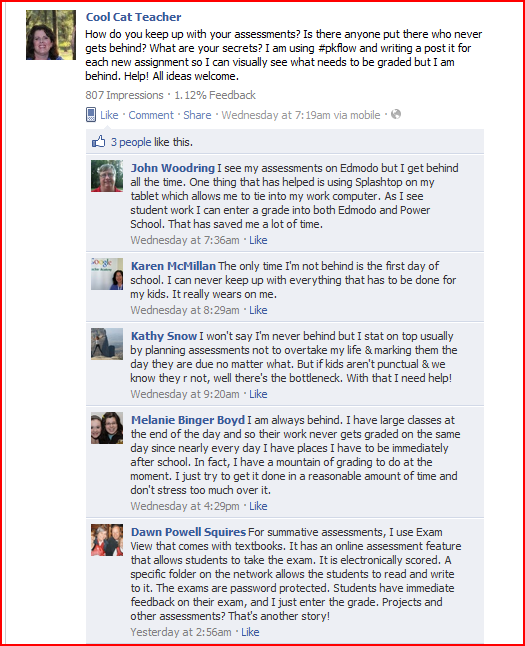 |
| Recent conversation about assessments. I keep coming back and learning more. |
It helps me to not feel so alone with my struggles. As long as people preserve the privacy of their students and keep it professional (which it has been so far) I find that I'm learning a lot.
Learning from Conversation
To me, the great value is often not in the neat and tidy packaged textbooks and books that come out but in the rough, nubby, conversations with real teachers who are struggling like I am to be excellent, teach in powerful ways, and engage students in rigorous learning experiences.
I had a teacher stop and talk to me at the church the other night and she was talking about her new principal. She is frustrated and said she just wants to ask:
"Do you want me to teach for this test or teach for their future?"
Because she feels that multiple choice just doesn't cut it. I find that by networking like this, I am learning for my future. So, this leads to my next question -- how are we letting students network for learning? Do they have places they can go for conversation to learn?
Learning Places for Conversation
I don't know the answer but we all have to get there. I know on our Flat Classroom Ning and Digiteen Edmodo that we work hard to have conversations. ON the Digiteen project we have one group Digiteen 11-3 and one group called recess and we work hard to have the social comments posted to recess. But it is Friday and I guarantee someone will go on the digiteen group and post, "I'm so glad its friday" and put a cute little moving avatar. And then another moving emoticon will be posted. And Another and another an dall the way down the page we'll see cute little moving avatars - pushing down the conversations about digital citizenship.
This is not a problem altogether. It is great for kids to talk. But we're working hard to teach kids context.
Where is the PLACE for that conversation?
Places should have a purpose. When they do and you establish community guidelines that are community enforced then it begins to work and that takes time. But you can't have community if you're in and out in the span of a few weeks. This takes long term relationships and community building. It will happen but right now onine learning is so much in "project" mode and we need to move to "place" mode with projects moving in and out via groups.
We need places with purposes so kids can have conversations that matter about learning. We need to help faciliate that. Facebook for them should be fun, but can't we have LearnBook? or the MathMatrix? or some places where kids can go for these purposes that are long term places for kids to join and move into the future?
Learning relationships and communities are needed in education and we haven't even begun to get there. Sure, I think Flat Classroom is a start, but I think Flat Classroom should be years and years long and should be more than about technology but extend to all subjects. We compartmentalize our departments so much that that sort of thinking is tough.
Lets ask ourselves these questions. I do think textbook companies should look at communities but right now I don't think they want to be in the business of linking up kids - I mean look at the headaches involved? The only way to do this is to create communities of practice undergirded by teachersourcing and community guidelines.
Conversation spaces will emerge but we have a long way to go. Let's start talking about it now.
Wednesday, October 26, 2011
Flat Learning Action Talks
F.L.A.T.s will officially launch tomorrow.
Our teachers have been talking about the fact that we need ongoing online pd and sharing of best practices. Also, that many webinars are sort of long. We want to have bit sized presentations with time to ask questions. Our first FLAT will be tomorrow and features two of our certified teachers presenting their take on developing a global project. Join us!
On Thursday October 27, 2011 at 8:00pm Eastern USA [time where you are - http://www.timeanddate.com/
Amy Jambor and Sheri Williams will present “Developing a global project” as a Flat Action Talk. Please join us at http://tinyurl.com/
#teaching starts In my Room
Room in My Classroom
When frowns are down and people are milling around...
It's time to hide in your room.
When people are tired and with caffeine over-wired
It's time to hide in your room.
When no one has slept and some negativity has crept
It's time to hide in your room.
You see, doom and gloom may loom
but not in your room.
Your classroom is your room, your creation, your loom,
you can do a lot in your room.
The most important attitude that walks in your door
is the one you bring into your room.
Protect your attitude with a shield of stone, keep the negative out
don't let it in your room.
Schools go up, schools go down,
but insulate the learning in your room.
Students must learn every day, it cannot fluctuate with ebb and sway
keep things consistently positive in your room.
My mom was a teacher and she taught me true
one of the only places in this world that is yours
is your classroom.
Own it. Love it. Nourish it. Protect it, even from yourself.
Even when it means you must hide
from the stress outside
by hiding in your room.
Oh teacher, this is your room!
It is yours.
Because when those two legged treasures walk in the door
they inhale everything you bring to your room.

When frowns are down and people are milling around...
It's time to hide in your room.
When people are tired and with caffeine over-wired
It's time to hide in your room.
When no one has slept and some negativity has crept
It's time to hide in your room.
You see, doom and gloom may loom
but not in your room.
Your classroom is your room, your creation, your loom,
you can do a lot in your room.
The most important attitude that walks in your door
is the one you bring into your room.
Protect your attitude with a shield of stone, keep the negative out
don't let it in your room.
Schools go up, schools go down,
but insulate the learning in your room.
Students must learn every day, it cannot fluctuate with ebb and sway
keep things consistently positive in your room.
My mom was a teacher and she taught me true
one of the only places in this world that is yours
is your classroom.
Own it. Love it. Nourish it. Protect it, even from yourself.
Even when it means you must hide
from the stress outside
by hiding in your room.
Oh teacher, this is your room!
It is yours.
Because when those two legged treasures walk in the door
they inhale everything you bring to your room.
Tuesday, October 25, 2011
Jailbreaking Education
"Should jailbreaking cell phones be part of my research project, 'Miss' Vicki?" said the eager Digiteen student as if a light bulb had just gone on.
"Tons of people are starting to jailbreak phones and I'm not sure if they understand if they should or what the impact is. I think it should be part of our recommendations."
"Is jailbreaking a phone part of legal, copyright, and fair use?" he said, quoting his subtopic on the project.
In just a few short sentences I was whirled away on a new inquiry and cutting edge issue of students today. I remember several years a go when some students came to me concerned that too many teens were sleeping with their cell phone in hand or under their pillow. They said it at least six months before news media outlets picked it up. Cyberbullying was on their radar at least five years ago when the project first started including text bombing.
This is why students should be at the forefront of digital citizenship research and recommendations. They can aggregate research and have personal perspectives that adults simply cannot have. That is precisely where we put them in the Digiteen project, too.
Every student has a slightly different research topic. Designed in such a way to make them think, it is challenging to coach each of them to understand their topic. Last Friday as we were continuing our authentic research phase of the Flat Classroom project, I had a student take my breath away,
"'Miss' Vicki, can't you just give us a worksheet? I don't feel like thinking today."
What? Did she just say what I think she said? Did she just confirm my whole teaching strategy in one sentence? My response was,
"Your brain is a required school supply for this class. You have it and you must use it. I don't give homework so I need your brain for at least 50 minutes today. I'll help you if you get lost."
Then, another comment,
"Well, who has the same topic I do. I can just look on their screen."
The answer was that no one has the same topic. Not on these projects. If two kids have the same topic at a school they are supposed to be in different classes, separated by time and space, so that each student will learn how to research.
I talked about this with one of my classes yesterday. I always want my students to know WHY we do things in my class. "Cause I said so," isn't good enough. I want them to know why we learn the way we do and why I do these odd, really hard things to get them thinking. I asked the simple question,
"Why don't we all do the same research project so we can learn together?"
One student blurted out,
"Because everybody knows that a few kids do the research and everybody just asks them and says the same thing those two or three people say, that's how it always is when we research the same topic."
Everyone nodded their heads - some sheepishly.
I want you to hear what these students are saying because these students are at an excellent school with great results and great teachers. Worksheets are not the norm. But these kids without an ounce of educational theory know which one requires thinking and which one does not.
Jailbreaking Education
Currently, we have a mass production model of education. But until we personalize things and require each student to learn. Until we do things in creative ways that make sure kids each learn and have to think and process, we will continue to have the select few do the thinking. It is human nature.
Education shouldn't be one size fits all. I don't think that getting outside the standardized work we do in education should be considered jailbreaking. But for now, in most schools it is.
Typically, the number one complaint of schools and why they can't embark on global collaborative projects is that there is no time in the curriculum. The other issue I've seen is that a teacher who only has kids twice a week and is tasked with 150-200 kids is asked to do such a project. I have 85 kids on 2 projects right now and I'm totally worn out at the end of the day.The schools that have done such scalable contributions to global collaborative projects (like the the amazing teachers at the Berea School district in Ohio) have good student to teacher ratios that allow for coaching. (Don't let Berea's website fool you, they are as sharp as they come.)
Higher order thinking and deep, wide technology integration where students build PLN's, use social bookmarking, use educational networks, collaborate on wikis, and produce profound multimedia cannot be relegated to a one-lesson "now you know a tool" approach. It requires immersive, experiential learning and that takes time.
Teaching right now for me is completely exhausting but completely fulfilling. In fact, right now we're talking on my facebook page about how to "work a room" in a way that doesn't completely wear out the teacher. My biggest struggle is energy level. It is exhilarating but it is also exhausting.
But to get here requires giving each student an individual research topic with a team of collaborators from other schools and a powerful network of teachers committed to help and support each other across country borders and district guidelines.
This kind of teaching is tough but it is real. I just find it so interesting that I and the other teachers feel that so much of what we do is frowned upon as some sort of "jailbreaking" that "most" schools can't do. This is what every school should do in a globally connected world. To say that you don't have time because you have to prep for a standardized test is sad.
Remember your noble calling teacher.
Sorry, I didn't have time to add photos this morning, I may come back and add them later.
Wednesday, September 21, 2011
Little Things Mean a Lot

This is the view from where I sit right now. I am taking up money at the softball gate in 90 something degree weather in the hot blazing sun. Or I was a minute a go.
A Little Umbrella
Another teacher came by and she gave me her umbrella. It means a lot because now I can read, grade papers on my iPad, and blog!
You can see the umbrella there in the picture looking out on the field where our 16-0 football team is practicing. (3-0 on this season) If you look hard, you might just see our headmaster / head football coach, Ross Worsham, out there working.
I mention him because he did a little thing on Monday in our faculty meeting. Except it meant a lot.
A Little Question that was a Big Deal
Ross read our devotional made 3 announcements and then he said,
"I want to hear from you. Is there anything I need to notice or be aware of even if it is little, I want to know."So the teachers told him a few little things - noise in the hall after middle school lunch and small things that if left unchecked could have grown.
The fact that he asked, listened and acted meant so much! In fact this may just be a little thing that means everything. I wish every school could be gifted with a man as good as Ross Worsham and a woman as good as our curriculum director, Betty Shiver. They are in our rooms, they work hard, they love us and the students. We love them.
It is the little things that mean a lot.
If you are a principal or administrator out there, I hope you'll ask and care about the little things. If you are afraid to ask, you have problems.
If you are a teacher, you can do little things that mean a lot too! Loaning an umbrella is just the beginning.
If you are a parent, you can encourage. I used to buy my son chocolate milk and put a sticky note one it and say " Love, Mom." The way to my son's heart is his stomach and beef jerky, gum, chocolate milk, and Big Macs all help him know I love him. (I did draw the line last week when he asked me to bring him 4 Big Macs after football practice- I told him 3 was enough. But you get the point!)
Will you take a minute today, right now and do something little? It might just mean a lot!
Due to a blogger API problem this could not be posted live from my iPad. I have found that both Diigo (they fixed it in less than 24 hours after I emailed them) and Blog Press on my iPad wouldn't link to my blogger account!
Subscribe to:
Posts (Atom)
My Blog List


Popular Posts
-
There seems to be no stopping the success of the iPad, with the iPad 2 selling out in major markets like Europe, America and Australia almo...
-
Have you been looking for an easy way to root your Toshiba Thrive AT100? If your tablet is running on Android 3.2.1 Honeycomb, we have jus...
-
Last week, companies like Nokia and Samsung were able to showcase their new devices at the 2012 (MWC) Mobile World Congress. The four-day e...
-
Writing Better Blog Posts: What You NEED to Know | The Edublogger Excellent post from Sue Waters abo...
-
 Home Screen of my Flipboard Flipboard is a phenomenal reading app for the ipad and was the big reason I begged my family to give me one fo...
 -
Samsung is one of the most important companies in the smartphone and mobile business, but the South Korean giant is apparently not happy w...
-
Masterbet88 Grand Opening Promo Bonus 50% Sportsbook dan Casino Online
-
Facial recognition system in iOS 5 Are you impressed by the selection of apps available on iOS devices? Wait ‘till you hear about the iOS 5...
-
We’ve first heard about Lenovo K800 Android phone in January and we knew by then that the Chinese market would be the first one to see th...
-
The Asus Eee Pad Transformer TF101, with its dual-core 1.0 GHz NVIDIA Tegra 2 processor, is the ultimate tablet on the go. Combined with a...


