-
Parents’ behavior linked to kids’ videogame playing | MSU News | Michigan State University
Parents who have negative relationships with their children are more likely to have kids who play video games. I don't know. What causes the negative relationship? Aren't teenage boys attracted to video games. ARen't they more likely to have tension with parents anyway. Here is a classic case of causation or correlation.
Friday, September 16, 2011
Daily Education and Technology News for Schools 09/17/2011
Thursday, September 15, 2011
Monday, September 12, 2011
A Roundup of Reading Research
Get the facts when you're teaching a child how to read.
I have a child with dyslexia and one of my biggest ambitions is to help my children love reading. Mrs. Grace Adkins in our learning lab is an invaluable help in this way and sent me some links to current research on the topic. I may not be an official "reading" teacher but I am my child's reading teacher.
I cried this summer when my fourth grader became so fluent that he's poured through one of the Chroncile of Narnia books and is now on his second book. He reads every night with me - we take turns and he's nailing it. I really wondered if I'd ever see the day. We've done multisensory everything, spent summers, extra help, whatever it takes. Reading opens up the world and is dear to my heart. I love it and I want my children to love it too!
A book recommendation from Mrs. Adkins
Mrs. Adkins just sent me a note recommending this book: Ready to Read: A Multisensory Approach to Language-based Comprehension Instruction and also sent some other resources across my desk for looking at the research behind teaching reading.
Read up on Reading Research
You don't have to be the expert to read what the experts say and break it down into practice. As I"ve shared before, it is appalling that so few people like to read and how many never pick up another book after high school or college. (See my post Time to Get Angry About Reading.)
I've got a whole list of reading resources I've pulled from the web in a Diigo list, so please take a look, but here is a list of some great PDF's that you'll want to read.
Round Up of Reading Research
 This guide is from Dr. Louisa C. Moats and the International Dyslexia Association. It bridges research into practice to create a "research-based tool for practitioners." These are the standards used by the IDI to guide teachers of reading, spelling, and writing.

I have a child with dyslexia and one of my biggest ambitions is to help my children love reading. Mrs. Grace Adkins in our learning lab is an invaluable help in this way and sent me some links to current research on the topic. I may not be an official "reading" teacher but I am my child's reading teacher.
I cried this summer when my fourth grader became so fluent that he's poured through one of the Chroncile of Narnia books and is now on his second book. He reads every night with me - we take turns and he's nailing it. I really wondered if I'd ever see the day. We've done multisensory everything, spent summers, extra help, whatever it takes. Reading opens up the world and is dear to my heart. I love it and I want my children to love it too!
A book recommendation from Mrs. Adkins
Mrs. Adkins just sent me a note recommending this book: Ready to Read: A Multisensory Approach to Language-based Comprehension Instruction and also sent some other resources across my desk for looking at the research behind teaching reading.
Read up on Reading Research
You don't have to be the expert to read what the experts say and break it down into practice. As I"ve shared before, it is appalling that so few people like to read and how many never pick up another book after high school or college. (See my post Time to Get Angry About Reading.)
I've got a whole list of reading resources I've pulled from the web in a Diigo list, so please take a look, but here is a list of some great PDF's that you'll want to read.
Round Up of Reading Research
Knowledge and Practice Standards for Teachers of Reading International Dyslexia Association
This guide is from Dr. Louisa C. Moats and the International Dyslexia Association. It bridges research into practice to create a "research-based tool for practitioners." These are the standards used by the IDI to guide teachers of reading, spelling, and writing.the Research Building Blocks for Teaching Children to Read
The updated 2006 copy of the National Reading Panel teacher's guide to give a framework for using the findings of the 200 national Reading Panel in the classroom. This is another guidebook for teachers and curriculum directors.
Teaching Reading: Report and Recommendations, National Inquiry into the Teaching of Literacy
This December 2005 report talks about best practices in teaching literacy. For those of you who like to review best practices from around the world, this came in from the International Dyslexia Association in their Summer 2011 Perspectives on Language and Literacy "Global Perspectives" column.
Independent Review of the Teaching of Early Reading : The Department for Education
Here is another study for literacy people. This report from the UK talks about effective teacher training and good teaching methods but interestingly talks about early reading instruction and the debates surrounding whole language and constructivism.
Remember your noble calling, teacher. Take time to read and learn -- you expect your students to do it too!
Saturday, September 10, 2011
Death, Taxes, and the Poison Pen

I'm all of those things.
- September 11th makes us all sad.
- Business taxes are due Thursday and the headache is unbelievable this year w/ Flat Classroom, Cool Cat Teacher and my old hosting business.
- The Flat Classroom book is so close and in final copy editing mode but a last minute glitch with some important graphics has me ready to jump.
- I haven't been still or really rested in days.
I'm tired. More than tired.
Last night, my son's football team which has been blessed to win 15 straight games (state champs last year) won 43-0. There was a poor boy on the other team who was so tired and played the whole game. He kept falling to his knees after every play gasping for air and then he'd pull up again to go play again. He didn't quit but I kept pointing him out to my husband but inwardly I admired his tenacity. He didn't quit and he was an important part of his team, even though last night they had a tough fight.
Right now I feel like that boy.
But I know this. The feeling of hopeless exhaustion won't last forever. I felt that just before I had each of my children. They almost killed me -- especially my daughter - all 10 pounds 3 ounces of her (she's now 6'1".) I felt like I couldn't do it. Like it would kill me. Like I couldn't make it one more minute.
The biggest pain comes just before the last push.
The biggest scream before the greatest accomplishments are born.
The toughest roads are up mountains.
I take comfort in the thought of Winston Churchill bunkered underground during World War 2 telling the people of the world:
"Never, never, never, give up."
It is on my fridge on a magnet.
As I pour a glass of milk I lean my check on the freezer door soaking in the coolness and contemplating these things.
"Surely goodness and mercy will follow me all the days of my life."
I'm called here. I'm doing what I'm called to do by One who loves me. All is not lost. Hope is not gone.
Joy comes in the morning.
Night y'all.
Friday, September 9, 2011
Picking the Perfect Font for Beautiful Designs Every Time

A font is a
"set of type."
When writing my graphic design curriculum, I turned to my sister, Sarah Adams, who has three degrees in the subject, is an online professor for a major art university, and owns her own firm. (If you've seen a magazine in the US, you've seen her ads - designed right down the road here in Camilla, Ga.)
There are two basic decisions that you have to make about a font: the font face itself, and the font size.
I'm going to come back to font face and font families in a later post, but first lets assume you're using ONE font family and look at selecting font size.
Pick the Perfect Font Size Using The Font Formula
0-1-1-2-3-5-8-13-21-34-55-89...
Yes, this is called the "Font Formula" by many graphic designers but the rest of us know it as the Fibonnaci sequence. This series of numbers always starts with 0 and 1 and then becomes the sum of the 2 numbers before it. 0+1=1, 1+1=2, 1+2=3, 2+3=5... and so forth.
The interesting thing about this sequence is that you can take the ratios of two numbers in line 3/5 or 55/89 for example and you get closer and closer to the Golden ratio (also called the "divine proportion.") No one can really explain it, but the Golden ratio is found in many things including geometric patterns.
 |
| In this case, I picked 3 Fibonnaci numbers in order. |
Here is how it works. When you want to select two font sizes, pick two of the numbers from the sequence. So, a 34 and a 13 would look very nice together.
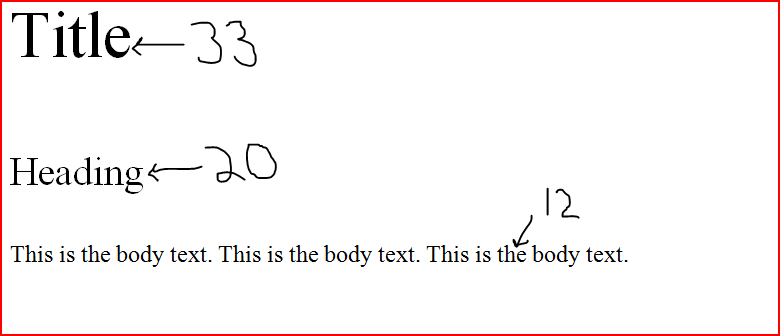
But we know that the "ideal" font sizes for 'body' text run between 10 and 12, so, say we wanted to have a 12 as a font size. Then, we would pick numbers from the font formula to help us pick our other one or two sizes.
So, If I have 12, I could add 8 and go with 20 and add another 13 and have 33. So, my body would be 12, my headings may be 20 and my title may be 33.
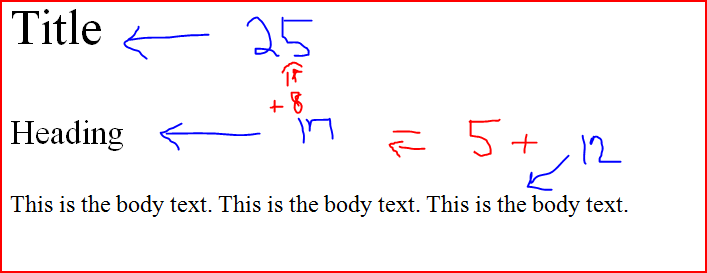 |
| Picking font sizes using interpolation. |
But what if I don't want to have that big of a difference? I could pick numbers lower in the sequence and interpolate in this case. So, I could say, OK, my body text is going to be 12, I'm going to add 5 and use 17 for my headers and add 8 and use 25 for my title.

There is still a place for "eyeballing it."
Since my sister taught me this formula, I use it quite a bit and teach it to my students. I have the Fibonnaci sequence on a piece of paper right on my keyboard so I can just grab it.
You DO have to learn to type the font size manually in most programs because most programs don't use the odd numbers required to pull from the sequence. As for blogging, you can barely pick the size at all.
I've also found that there is also a place for eyeballing it. I've found that the higher up in the numbers I go, the better the differences between the fonts looks. (I guess that would make sense because you get closer to the golden ratio as you go higher.) But I've also found that sometimes I really have to eyeball it.
Some fonts are just different and I have to play with the numbers using different intervals from the Fibonnaci sequence to get what I'm looking for. But overall, I've found that this method of selecting font sizes (especially when in the same font face) is usually dead on.
The Books to Teach Graphic Design
Never use a software book to learn graphic design principles. I believe you should be concept focused, not tool focused. Know the principles and then you can use them anywhere.
If you want to teach graphic design in your classroom, there are two INCREDIBLE books that Sarah had me use for my graphic design curriculum. Every technology teacher should have these two books.
- Non-Designer's Design Book, The (3rd Edition)
by Robin Williams (not the comedian) I actually have my students in my Graphic Design Semester long course purchase this book to keep.It is that good.
- The The Non-Designer's Type Book, 2nd Edition
which really helped me understand typography.
- Note that Williams combined these two books into The Non-Designer's Design and Type Books, Deluxe Edition
(so if you want both of the older copies, you could combine them.
 but I would still get the graphic design book first. It is probably my next read on this topic.
Other Books I use to Teach Graphic Design
Photography
By the way, if you have a course where you also have the students take photographs, Sarah got me hooked on this The Digital Photography Book
 series by Scott Kelby
Presentations
Presentation Zen: Simple Ideas on Presentation Design and Delivery

By the way, did you know Garr Reynolds has a new Presentation Zen: Simple Ideas on Presentation Design and Delivery (2nd Edition) (Voices That Matter)
 coming out. I'd have to see this one to figure out which one I'd use, but knowing Garr's work, I'd use the newer one.
This post is dedicated to Sarah Adams, tied for best sister in the world. You aren't a baby sister any more, you are one of my best friends in the world and I cherish your wisdom, intelligence and perseverance. You are the first person who taught me how technology could unlock the greatness of a person and I'm so proud of your accomplishments.
She is tied up with some big jobs or probably would have written this post. She did agree to look over this post and let me know if there are any clarifications I need to share with you. I'll not corrections when I make them.
Hat tip, also, to my Twitter friends @datruss @nesticos @dkuropatwa @prlowe91 who got after me on Twitter and asked me to write this blog post. There are so many things like this that I just teach and don't realize that they are special.
One benefit of tweeting is that others can tell you when something is important enough to birth into a post. Expect more from me (and Sarah) on this topic. She's spent hours infusing concepts into my brain in a way simple enough for me and my students to understand.
I have to almost admit that I was afraid to write this post, I had someone who got after me for a grammar mistake not too long a go and I added and re-added my math here. Is that silly? I guess that is what criticism does sometimes. But we share ANYWAY.
Photo Credits:
iStock Photo
Thursday, September 8, 2011
Failure to Communicate: When it is time to abandon the Betas.
"What we have is a failure to communicate,"says the warden to Cool Hand Luke in the movie by the same name.
Exactly.
Between Firefox 7 Beta, the add ons for the browser, my free antivirus software Avast, and the upgrade to Blogger, something is wrong.
I have several computers that I work on: my Vista PC at home, my large Win 7 Lenovo Think Center m90z at home, and my HP Win 7 64 bit laptop at school. All nice, well tended machines.
But there are times when NOTHING works right and I've been having them for the past three or four weeks with this blog.
It came to a head on Monday when I wrote an excellent post responding to a New York Times article that I dare not link to. Not because I don't want to give you the link, but because, I've found if I open a different window and go there and copy the link, that somehow blogger will stop responding as it tries to save a draft and I'll lose this post too. I lost that post. I hope to write it again -- when I have time.
I try Firefox and Chrome and sometimes it happens in both, so it might actually be Blogger. But sometimes I'm not on blogger or anything like it and suddenly the new windows I open in Firefox or Chrome suddenly stop responding at all. The little circle just turning around and around.
It just isn't anything I can put my finger on, nothing I can really point to. I have Avast at home and AVG at school - nothing there. I use a heavy duty firewall at home and a gateway firewall at school - again a disconnect. I typically crash in Blogger and the one time I opened a post to resurrect it at school, it crashed on me there too.
Technology is an ecosystem. It is becoming harder to troubleshoot - at least for me.
I find it hard to believe that all three of my systems have problems - in fact, I'm pretty sure that they don't. Unless I just attracted unwanted interest on that post about Kevin Mitnick's new book that my sister berated me for even writing: Dumb, Dumb, Dumb,
"Vicki, never write anything about hackers lest they turn on you." she said.
Yes, but still. I guess there is a person in me that wanted to speak up for those people hurt by the book that will never even know I wrote the post - OK, so I guess I'm a bit dumb. Or perhaps just idealistic.
So, I've just written a dead, linkless post just for the sake of writing one, I guess. I may have to fire up Windows Live Writer and start blogging in there again - it is a nice offline blog post editor. I love using the Zemanta add in and have it on Firefox although there are problems in Chrome where I don't have the add in.
Something's just not quite right. I'm still here. I have an epic post I'm working on about parenting and another one as well.
The other problem is that I've had to disable my Diigo plug in on Firefox 7 and that is what I use to send you your daily spotlight. So, the question is - What is going on? I'm going to figure this out. It isn't that I'm not writing - I'm writing more than ever with the final proofs for the Flat Classroom Book due this week and the new book on collaborative writing's first deadline this past Tuesday.
I've got lots to write about and share with you. It is just somehow when I open this trusty blogger window, I always get hung.
Maybe it is time to un-beta everything and just go back to what works. Maybe that is what I will try next. There is a time when Beta products are in beta for a reason and now may be one of them.
Until then, remember your noble calling, teacher. Remember that great work often has great obstacles and that we have to keep on plugging ahead anyway.
Remember your noble calling, teacher. I will.
Sunday, September 4, 2011
The One Habit that Will Immediately Reduce Your Stress
One of the most unbelievably annoying things in my house is to run out of cat food. We have two cats and they just go crazy.
Then all I hear is
It escalates until it is is unbelievable.
You can't get anything done. Don't pass Go. Don't collect $200. Don't even breathe.
GET CAT FOOD, STAT.
This Saturday I jumped up out of bed at 7am ready to write and there they were with eager paws and whiskers twitching.
They descended in feline fury upon me and, you guessed it, I ended up going to Wal-Mart before being able to fire up my computer and start writing. Then, I saw I needed toothpaste and Cascade and several other things. I went ahead and started laundry while I was at it. So, I started at 9:30 am after one thing that led to another.
That is what happens when a little thing is allowed to slip until it becomes a big thing. The cats will nag when they aren't fed. It is a law of nature. Then, you will lose focus. It is a habit of humans who have let the urgent usurp the important.
Avoiding the Cat Nag
This is what we call the "cat nag" in my house.
It means that we haven't taken care of business and have let something get to a critical state so that everything else comes to a stand still until that one need is met.
Paper in the printer. Ink in the printer. Getting behind on grading. Running out of Milk.
I"ve blogged about these things before when I talked about applying the Pareto principle to your life but this is sort of different.
What are the things that bring your life to a standstill? Index cards for the kids? Pens. Pencils?
What about in your classroom? Dry erase markers? An eraser? What are the things that bring your life to a halt?
These things should go on a checklist.
Step 1: Prepare Your Punchlist
Sit down at your table now and make two lists. Make a list at home of the things that "bring the cats running."
What things bring everything to a standstill forcing you to go to the store or interrupt your schedule?
Do the same for your classroom. What are the things that bring the classroom to a standstill and force you to attend to that problem? (And we know what happens when the students know you're distracted or you have to go to the copy room to get more paper!)
It is tough enough to teach but when a small thing keeps you from teaching, that small thing is a big thing.
Look at your two lists and work to figure out how much of those things you need a week. If you're not sure (like dry erase markers) then your list would say:
"Clean board. Check dry erase supplies."
Step 2: Make a Weekly Appointment to Punch Out Your Punchlist
Now, make an appointment with yourself where you will do the items on your punchlist. For me, at school I do my list every Wednesday at 11 am and at home, I do it every Saturday morning. My goal is to handle those items once a week.
So, at school this punchlist looks sort of like this:
"Good morning, Boots."
"Meow."
"Morning, Crispy."
"Reow" (Yes, he has an "r" sound instead of the "m")
Then all I hear is
"Meow. Reow. Meow. Reow."
It escalates until it is is unbelievable.
You can't get anything done. Don't pass Go. Don't collect $200. Don't even breathe.
GET CAT FOOD, STAT.
This Saturday I jumped up out of bed at 7am ready to write and there they were with eager paws and whiskers twitching.
They descended in feline fury upon me and, you guessed it, I ended up going to Wal-Mart before being able to fire up my computer and start writing. Then, I saw I needed toothpaste and Cascade and several other things. I went ahead and started laundry while I was at it. So, I started at 9:30 am after one thing that led to another.
That is what happens when a little thing is allowed to slip until it becomes a big thing. The cats will nag when they aren't fed. It is a law of nature. Then, you will lose focus. It is a habit of humans who have let the urgent usurp the important.
Avoiding the Cat Nag
This is what we call the "cat nag" in my house.
It means that we haven't taken care of business and have let something get to a critical state so that everything else comes to a stand still until that one need is met.
Paper in the printer. Ink in the printer. Getting behind on grading. Running out of Milk.
I"ve blogged about these things before when I talked about applying the Pareto principle to your life but this is sort of different.
What are the things that bring your life to a standstill? Index cards for the kids? Pens. Pencils?
What about in your classroom? Dry erase markers? An eraser? What are the things that bring your life to a halt?
These things should go on a checklist.
Step 1: Prepare Your Punchlist
Sit down at your table now and make two lists. Make a list at home of the things that "bring the cats running."
What things bring everything to a standstill forcing you to go to the store or interrupt your schedule?
Do the same for your classroom. What are the things that bring the classroom to a standstill and force you to attend to that problem? (And we know what happens when the students know you're distracted or you have to go to the copy room to get more paper!)
It is tough enough to teach but when a small thing keeps you from teaching, that small thing is a big thing.
Look at your two lists and work to figure out how much of those things you need a week. If you're not sure (like dry erase markers) then your list would say:
"Clean board. Check dry erase supplies."
Step 2: Make a Weekly Appointment to Punch Out Your Punchlist
Now, make an appointment with yourself where you will do the items on your punchlist. For me, at school I do my list every Wednesday at 11 am and at home, I do it every Saturday morning. My goal is to handle those items once a week.
So, at school this punchlist looks sort of like this:
- Check ink in printers (If I'm below 50% in ink, I go ahead and order more.)
- Get paper from copy room (I keep 4 reams of paper which is more than enough now that my student work doesn't require paper.)
- Wash and clean board. (I throw away dry erase markers that don't work as I find duds and keep a certain number at my board.)
- Check my dropbox and make a list of all things I have to have graded by Friday (Grades are due Monday and my goal is to not grade on the weekends)
My "Home" (Saturday) punchlist includes:
- Restocking my fridge at school (after I get groceries I drive straight to the school and put the bottled water in my small fridge.)
- Check toilet paper and make sure there is enough for the week everywhere.
- Buy enough milk for the week (OK, this is a problem. On a good week it is 3 gallons - some weeks I admit the kids have had 8 gallons - I have three very tall kids who are growing a lot!)
- Making a list of chores for the kids to do that day based upon a run through of the house.
- Check cat food and dog food and buy more if needed.
- Check pens, pencils, and paper by the telephones.
- Check laundry detergent, check dishwashing detergent, shampoos, etc.
Not a lot of things. Just the things that will add to stress in my life. Who wants to leave the house at 9:30 pm to go get one thing at the store?
This one thing has helped me a lot. I know that stress will happen, but why waste my time and anxiety on the doggone cats?
I had that epiphany on Saturday and thought I'd share it with you. Sounds like I need to follow my own guidelines more closely or just realize that my cats may have started eating like my kids and I need to buy a little more. ;-)
Remember your noble calling, teacher. Do what you can to plan ahead so you have less stress in your life and can focus on the most important thing in your classroom: your students.
Subscribe to:
Posts (Atom)
My Blog List


Popular Posts
-
There seems to be no stopping the success of the iPad, with the iPad 2 selling out in major markets like Europe, America and Australia almo...
-
Have you been looking for an easy way to root your Toshiba Thrive AT100? If your tablet is running on Android 3.2.1 Honeycomb, we have jus...
-
 Home Screen of my Flipboard Flipboard is a phenomenal reading app for the ipad and was the big reason I begged my family to give me one fo...
-
Samsung is one of the most important companies in the smartphone and mobile business, but the South Korean giant is apparently not happy w...
-
The most popular social networking site Facebook launches its app center today. This is after all the reports that Mark Zuckerberg’s compa...
-
Writing Better Blog Posts: What You NEED to Know | The Edublogger Excellent post from Sue Waters abo...
-
We’ve first heard about Lenovo K800 Android phone in January and we knew by then that the Chinese market would be the first one to see th...
-
Masterbet88 Grand Opening Promo Bonus 50% Sportsbook dan Casino Online
-
 You need a break or you'll break... literally. Take some down time, help others, reconnect with your family, and get a head start on lif...
-
Last week, companies like Nokia and Samsung were able to showcase their new devices at the 2012 (MWC) Mobile World Congress. The four-day e...


